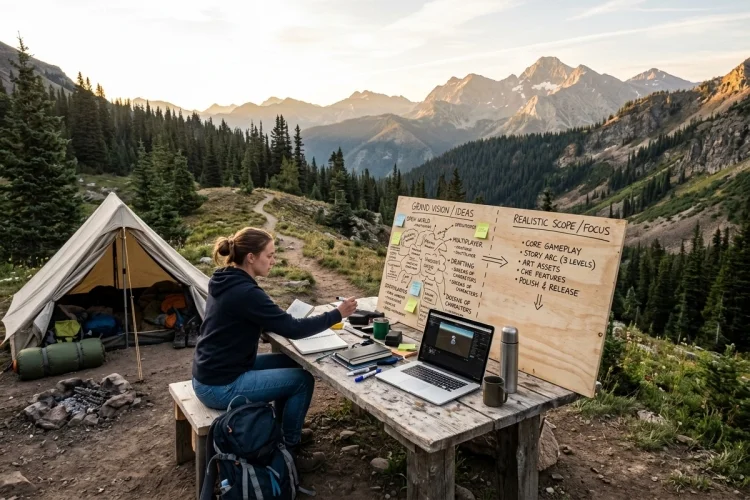
Most indie games do not begin with small ideas. Developers imagine large worlds, branching stories, dozens of characters, online multiplayer, crafting systems, and endless post-launch content.
The excitement is real, but so is the amount of work hiding behind every feature. A realistic game scope is not about making your idea boring.
It is about choosing a version of that idea that you can actually finish with the time, money, skills, and people available to you. This is especially important for solo developers and small teams.
Every new mechanic creates additional programming, artwork, sound, interface design, testing, balancing, and maintenance. A feature that takes two days to prototype may require several weeks to make reliable and release-ready.
Learning how to define a realistic scope for an indie game helps you focus on its strongest qualities instead of spreading your effort across too many unfinished systems. The goal is not simply to start development-it is to reach a complete, polished, and playable release.
Understand What Game Scope Includes
Game scope describes the total amount of work required to complete a project. It includes more than the number of levels or estimated playtime.
Your scope also covers gameplay mechanics, characters, animations, enemies, environments, user-interface screens, audio, narrative content, save data, supported platforms, accessibility features, localisation, testing, marketing assets, and post-launch support.
For example, adding a fishing system may sound like one feature. In practice, it could require new controls, animations, fish data, inventory integration, sound effects, interface elements, balancing, tutorials, and save-system support.
Good project management begins with a clear scope, achievable tasks, milestones, and a schedule that reflects the resources available to the team.
Treat every proposed feature as a package of work rather than a single checkbox.
Start with Your Real Constraints
Before deciding what the game contains, identify what you actually have.
Consider your available development time, budget, technical experience, artistic ability, team size, hardware, software, and personal responsibilities. These limits are not obstacles to creativity. They are design constraints that help you choose an achievable concept.
Suppose you can work on the game for 10 hours per week over six months:
10 hours × 24 weeks = 240 available hours
Do not plan 240 hours of feature development. Reserve time for debugging, testing, store preparation, unexpected problems, and tasks you underestimated.
Keeping a 30% safety margin would leave approximately:
240 hours × 0.70 = 168 planned production hours
That number may feel small, but it gives you a more honest foundation. Unity’s game-design learning material similarly recommends treating time, skills, and available resources as constraints when defining a project.
Define the Core Player Experience
Write one sentence explaining what the player repeatedly does and why it is enjoyable.
For example:
The player explores short haunted buildings, avoids spirits, and photographs evidence before time runs out.
This sentence identifies the core loop: explore, avoid danger, collect evidence, and escape. Features that strengthen that loop deserve priority.
A complex crafting system may not belong unless crafting meaningfully improves exploration or survival. Competitive multiplayer probably does not belong if the intended experience is a focused single-player mystery.
Next, identify the game’s three most important design pillars. They might be:
- Fast movement
- Short strategic battles
- Meaningful equipment choices
When considering a new feature, ask whether it supports one of those pillars. If it does not, it may be unnecessary even when it sounds interesting.
Design the Smallest Complete Version
The smallest complete version is not an unfinished demo. It is a compact game with a beginning, a functioning gameplay loop, progression, clear feedback, and an ending.
A small action game might include one playable character, three enemy types, five short levels, one boss, a title screen, basic settings, sound effects, music, and a save or level-unlock system.
That version can still feel satisfying when every part is polished. By contrast, a project with 30 planned levels, 20 weapons, online co-op, and procedural worlds may never reach a stable release.
A Short Hike is a useful example of designing within limitations. Its initial release was developed around a four-month deadline, and its small scale influenced its visual style, world design, and writing approach.
That does not mean every game should take four months, but it demonstrates how firm limitations can encourage focused design.
Build the smallest version that communicates your idea well. Expansion can come after that foundation works.
Estimate Features by Their Full Production Cost
Feature estimates should include every department and every development stage.
Imagine that you want to add five weapons. Each weapon may require a sprite, animations, damage logic, effects, sounds, interface icons, balancing, enemy reactions, save data, and testing.
If one finished weapon requires eight hours, five weapons do not necessarily require only 40 hours. Shared systems may save time, but integration problems and balancing can add more work later.
Content also multiplies systems. A dialogue mechanic may be easy to program, but writing, editing, displaying, testing, and localising thousands of words is a much larger commitment.
Create one representative example before approving a full content list. Finish one enemy, one quest, one level, or one weapon to near-release quality. Record the time required, then use that information to estimate the remaining workload.
Your own production data will usually be more useful than another developer’s schedule.
Use Milestones and a Vertical Slice
Break development into milestones with visible outcomes. Useful stages might include prototype, vertical slice, content production, alpha, beta, and release candidate.
The prototype tests whether the main mechanic is enjoyable. The vertical slice creates a short section using close-to-final gameplay, artwork, audio, interface design, and overall quality.
A vertical slice helps reveal the true cost of production. You may discover that one polished level takes three weeks rather than three days, or that your animation style is too time-consuming for the planned number of characters.
Milestones turn a large project into smaller deliverables and make progress easier to evaluate. Unity’s production material recommends using milestones and a vertical slice to connect the early concept with a practical route toward completion.
GameMaker’s solo-development guidance also emphasises organising the end goal, intermediate milestones, and the individual steps required to reach them.
Create a Scope-Cutting Plan Early
Do not wait until the project is in trouble before deciding what can be removed.
Label features as essential, valuable, or optional. Essential features make the core game function. Valuable features improve the experience, while optional features can be cut without destroying the central idea.
Decide the cutting order in advance. You might remove additional character skins first, reduce the number of levels second, and simplify secondary quests third.
Cut depth before cutting clarity. Players need understandable controls, reliable saving, useful menus, and clear feedback. They do not necessarily need ten biomes or 50 enemy variations.
Reducing content is usually safer than removing an important system after the entire game has been built around it. A shorter polished game will generally make a stronger impression than a longer one filled with repeated or unfinished material.
Control Scope Creep During Production
Scope creep happens when the project continues growing after production begins. It often appears through harmless-sounding phrases such as “This would be easy to add” or “Players will probably expect this.”
Create a feature-freeze rule. New ideas go into a separate document rather than directly into the active development plan.
Review those ideas at scheduled milestones. A feature should enter production only when it clearly improves the core experience and you can remove or reduce something else of similar cost.
You can use a simple exchange rule:
No major feature enters the project unless another feature, content requirement, or equivalent amount of work leaves it.
Solo developers also need to account for energy, not just calendar time. A plan requiring constant overtime is not realistic simply because the hours technically fit.
Industry resources recognise excessive overtime, commonly called crunch, as a recurring development problem rather than a sustainable planning method.
Recalculate the Scope After Prototyping
Your initial estimate will probably be wrong. That is normal.
Once the prototype or vertical slice is complete, compare estimated time with actual time. Check which tasks were slower, which tools need improvement, and which features created unexpected dependencies.
If one level took 30 hours to complete, building 20 similar levels may require around 600 hours before additional testing and polish. Do not continue using the original estimate simply because changing the plan feels uncomfortable.
Reduce the level count, simplify the content, extend the schedule, or find additional help. Planning should respond to evidence.
GameMaker case studies from solo developers repeatedly highlight the value of planning the full production period, defining milestones, and managing scope according to real limitations.
A realistic indie game scope begins with honest constraints. Calculate the time, skills, money, and support available before deciding how many mechanics, levels, characters, and platforms the project can contain.
Focus on one clear player experience and build the smallest complete version that delivers it. Estimate features by their full production cost, test your assumptions through a vertical slice, and create a cutting plan before development becomes difficult.
Most importantly, update the scope when real production data proves your original plan was too ambitious. Open your current design document and identify the three features that define the game. Keep those strong, then simplify anything that distracts from finishing them.